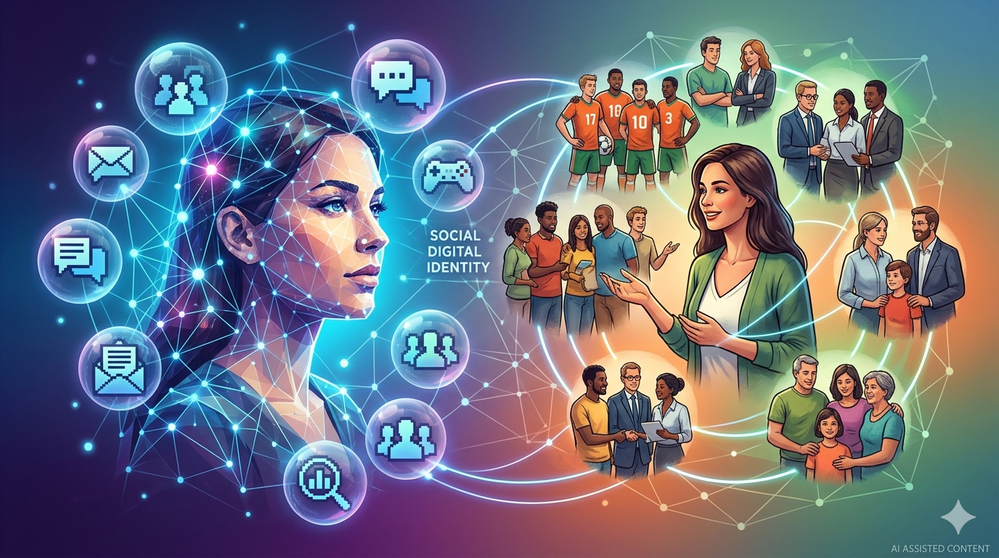
As our daily lives increasingly migrate to online platforms, understanding the mechanisms behind human interaction requires a sophisticated evolution of traditional psychological and sociological theories. A groundbreaking study published in Perspectives on Psychological Science offers a major advancement in this area by introducing Social Digital Identity Theory (SDIT). Developed by researchers William J. Bingley, Peter Worthy, and S. Alexander Haslam, this formalized framework integrates social identity approach dynamics with the unique technical structures of the online world.
Rather than viewing digital identity merely as an objective data-management footprint or a curated personal stage, SDIT focuses on the subjective, psychological reality of online group memberships. The authors posit that when individuals see themselves as part of an online collective, their digital identity shifts from a personal "I" and "me" to a social "we" and "us". This shift drastically alters how data-driven behaviors unfold online, predicting how group salience can fuel critical real-world outcomes like cybersecurity trust, algorithmic mediation, and digital polarization.
For social science educators and policymakers, SDIT provides a vital, empirical lens to analyze how platform-specific features—such as asynchronous communication, permanence, anonymity, and network symmetry—actively reshape human systems. The theory also introduces novel concepts like externalized perceiver readiness, suggesting that a person’s psychological attachment to a group can be externalized and stored within digital environments rather than relying solely on biological memory.
By grounding digital behavior in rigorous behavioral theory, SDIT provides social scientists with the precise framework needed to predict, evaluate, and address the real-world implications of our deeply integrated online and offline lives.
Source:




