
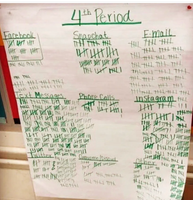
If you are choosing to read this post, you've probably seen the image below depicting all the notifications students received on their phones during one class period. You probably saw it as a retweet of this tweet, or in one of Zvi’s posts. Did you find this data plausible, or did you roll to disbelieve? Did you know that the image dates back to at least 2019? Does that fact make you more or less worried about the truth on the ground as of 2024?
Last month, I performed an enhanced replication of this experiment in my high school classes. This was partly because we had a use for it, partly to model scientific thinking, and partly because I was just really curious. Before you scroll past the image, I want to give you a chance to mentally register your predictions. Did my average class match the roughly 1,084 notifications I counted on Ms. Garza's viral image? What does the distribution look like? Is there a notable gender difference? Do honors classes get more or fewer notifications than regular classes? Which apps dominate? Let's find out! - to learn more from this article click here
Interesting Question to possibly be discussed:
Most of my students (even among top notification recipients) seem as well-adjusted with regards to their technology as professional adults. Only a few have an obvious problem, and they will often admit to it. What's not clear to me is whether those maladjusted teens would not, in the absence of phones, find some other outlet to distract themselves. 🔔As School Leaders What have you seen in your school communities?


